

Better begins here.
By partnering with LMG - with your brand or ours - our people, software and services work together to give you and your team the capability to do more for your clients.

.svg)
Deliver great customer outcomes and run a more profitable business.
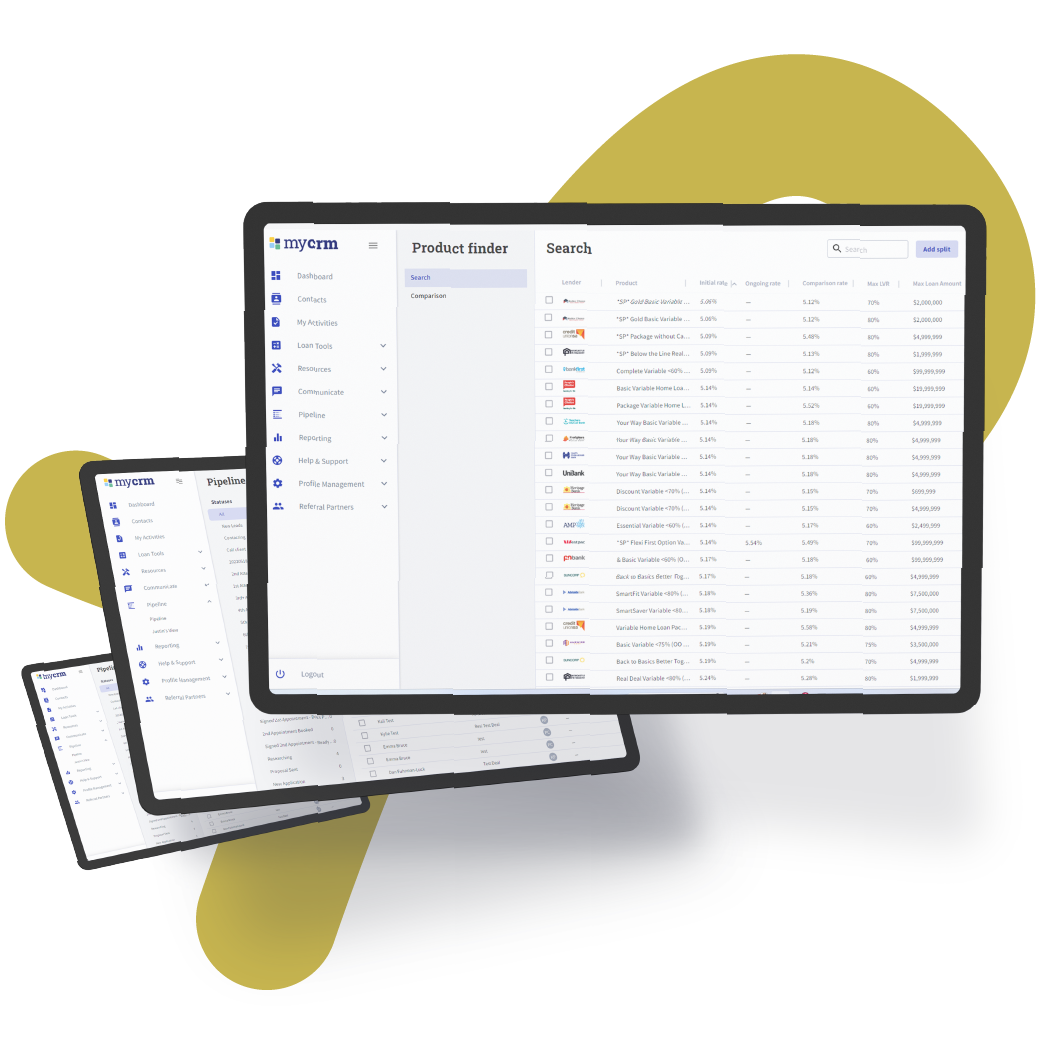
We do the heavy lifting on lodgement and compliance.
MyCRM, our paperless, all-in-one tech platform, is designed to save you time and keep you safe from lead to settlement and beyond. It’s the #1 software solution in the broking industry, as voted by brokers.
MyCRM powers every component of your business to help you run faster and smarter. It’s the engine behind the industry’s most productive brokers, enabling them to lodge deals faster and provide a simple, seamless onboarding experience for clients.

.gif?width=700&height=700&name=Home%20Page%20-%20Revenue%20Diversity%20TILE%20(1).gif)
Support to diversify.
With specialised support and platforms in residential, asset and commercial finance under one roof - it’s never been easier to diversify your revenue and build a smarter business.
Enhance your customer experience and build loyalty with our utility connection and insurance services. Take advantage of the industry’s largest broker network and generate additional income using our digital referral hubs.


Marketing tools.
Generate more leads and build your pipeline.
Whether building your own brand or leveraging our Loan Market brand, our industry-leading marketing platforms and expertise will ensure you stand apart from your competition.
Choose the marketing support you need, from marketing automation programs that help you find and keep clients to a full-suite ‘done-for-you’.

.gif?width=700&height=700&name=Home%20Page%20-%20CX%20TILE%20(2).gif)
Deliver a superior client experience at every touchpoint.
With software that puts your clients first and integrations that cut hours off each application, take advantage of a step-by-step digitally-enabled customer journey that helps you deliver a market-leading customer experience throughout the loan application process and life of the loan.
With a 60+ strong panel of banks and lenders to choose from, you’ll find a loan solution best suited to every client’s needs that’s in their best interest.


Benefit from being a part of Australia's biggest and most progressive broker community.
Whether you’re just starting out as a broker or a seasoned business owner with an established team, you’ll find a community right for you at LMG.
Learn from entrepreneurs with big ambitions, find growth mentors and participate in our learning and development programs, including daily webinars, personal development days and the industry’s biggest national conference.
Strong, long-lasting relationships and genuine camaraderie are created here.

We help brokers deliver better customer outcomes and run more profitable businesses.
.svg)
.png?width=715&height=945&name=Copy%20of%20Testimonial%20Head%20Shot%20(2).png)
“Choosing to aggregate with LMG came to be the best decision I made. From the first interaction I had with LMG, I felt that I was already 'part of the family'.”

ANNE SIMMONDS
MORTGAGE & FINANCE BROKER
.png?width=715&height=945&name=Copy%20of%20Testimonial%20Head%20Shot%20(1).png)
“Tech is really important and what LMG offers keeps me compliant, closer to my clients and more productive than before. But I was really drawn to how LMG had the support and coaching structures to help me grow - to really partner with me and lean in to where I wanted to get to.”
MEL WRIGHT
DIRECTOR & MORTGAGE BROKER
Benefit from being a part of Australia’s most progressive broker community

We come highly recommended.


.svg)